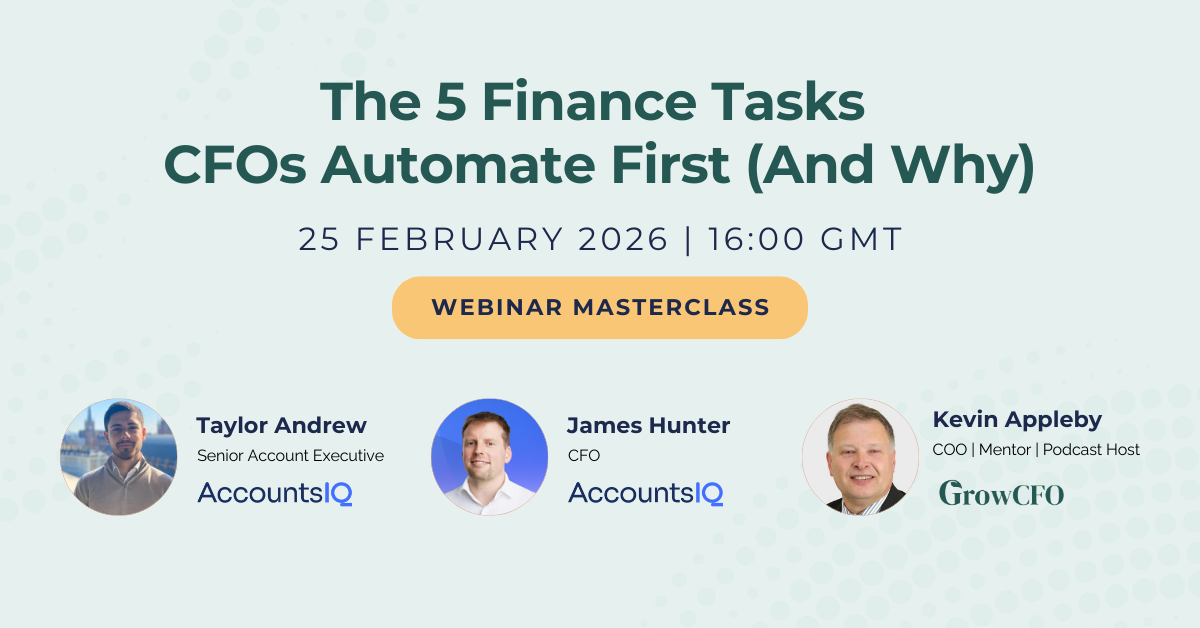
Automating the right finance tasks is now a strategic priority for CFOs, not just an efficiency play. In a world of increasing transaction volumes, complex multi-entity structures, and growing demands for real-time insight, CFOs need to free their teams from repetitive work so they can focus on control, scalability, and decision-making. This masterclass explores where automation genuinely adds value, how to avoid over-engineering, and why you must align people, process and technology before switching anything on.
In this session, James Hunter (CFO, AccountsIQ), Taylor Andrew (Senior Account Executive, AccountsIQ), and Kevin Appleby (COO & Podcast Host, GrowCFO) walk through five high‑impact use cases: accounts payable and invoice processing, approval workflows, banking tasks, intercompany and multi-entity processes, and dimension structures. They share real implementation stories—what worked, what failed, and why—plus practical advice on mapping processes, choosing tools, and using AI and automation without sacrificing control or governance. The result is a clear roadmap for finance leaders who want to modernize their function and get quick wins from automation, before moving on to more advanced AI agents and analytics.
Highlights:
- Why CFOs should automate outcomes-first, focusing on repetitive tasks where the value lies in completion (e.g. invoice posting, payment runs), not tasks where the insight comes from doing the work (e.g. budgeting)
- How to align people, processes and systems using “as‑is / to‑be” process mapping and swimlanes, so you don’t simply “shoehorn” broken processes into new technology
- The business case and pitfalls of AP automation and approval workflows, including the need for clear goals (insight, efficiency, control) and rigorous communication with frontline finance users
- Why banking tasks (bank feeds, auto‑matching, bulk payments) and intercompany / multi‑entity consolidation are prime candidates for early automation, reducing manual reconciliations and spreadsheet-based group reporting
- How a robust dimension structure (departments, projects, locations, revenue streams, etc.) lets you transact at the lowest level and instantly slice and dice P&L and AP/AR reports without exporting to Excel
- Where AI already fits today—OCR invoice capture, bank rec matching, and emerging AI agents—and why “human in the loop” governance and segregation of duties remain non‑negotiable for finance teams