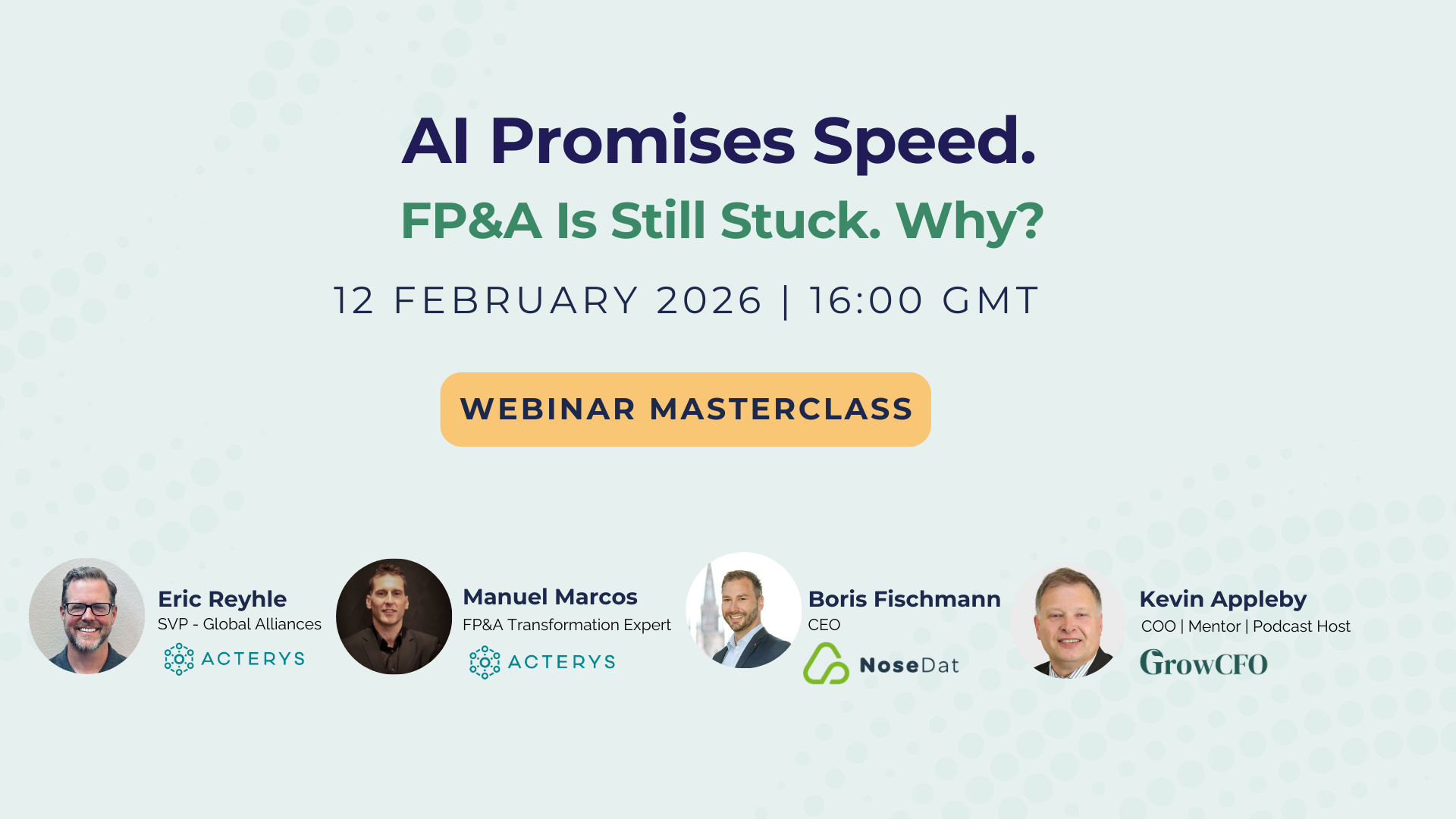
Artificial intelligence promises to turbo‑charge planning, forecasting and analysis, yet most FP&A teams still grind through manual spreadsheets, disconnected systems and slow month‑end cycles. In “AI Promises Speed. FP&A Is Still Stuck. Why?”, Kevin Appleby brings together Boris Fischmann (CEO, NoseDat), Eric Reyhle (SVP – Global Alliances, Acterys), and Manuel Marcos (FP&A Transformation Expert, Acterys) to unpack this gap between promise and reality. They explore why finance leaders feel intense pressure to react faster to volatility while their core FP&A processes remain constrained by messy data, legacy tools and bandwidth constraints.
The discussion shows that AI only delivers real speed once foundations are in place: clean, integrated data; a harmonized “single version of the truth”; clear ownership and governance; and realistic, well‑scoped use cases. The panel walks through practical steps to get from today’s spreadsheet‑heavy reality to AI‑enabled continuous planning – from anomaly detection and data quality checks, to unified data layers and write‑back, to real examples such as an 18% revenue uplift from AI‑driven replenishment. The result is a pragmatic playbook for FP&A teams who want AI to move beyond hype and start delivering measurable value.
Highlights:
- Why FP&A feels “stuck” despite AI hype: data silos, legacy systems, and overstretched teams block meaningful progress.
- The non‑negotiable foundation: a harmonized, governed data layer that finance can trust and defend in front of the business.
- How to start small: focus on narrow, high‑impact use cases (e.g. forecasting, replenishment) instead of boiling the ocean.
- Building trust in AI: why explainability, accuracy checks and anomaly detection are essential for finance sign‑off.
- Real‑world impact: examples of AI‑enabled FP&A delivering material gains such as double‑digit revenue uplift when data and process foundations are right.
- The path forward for FP&A leaders: shift mindset, fix data, then layer AI to enable faster, more frequent planning and decision‑making.